Posts

Showing posts with the label economy

Bogglers Block

Image
When I wrote my first post to this blog Dec. 29, 2009, Disruption is Coming , I committed to a post every week within the themes of the future, technology, and education.  I held to that until May 6, 2012.  My wife and I went on our first European vacation in that month and both disconnected from blogging and Twitter.  Again in August, I only wrote one post and on Christmas break, skipped a week.  This past summer I skipped six weeks of blogging – it was awesome.  It would seem that blogging has become a bit of a chore for me and I’m having some difficulty with the commitment to write regularly.  I guess after 171 posts, I’m struggling to find inspiring new things I want to write about.  Perhaps I have ‘bloggers block’.  This post is a think-out-loud on some concerns I have on my mind about the three themes for this blog. The more I read about the future the more concerned I become.  Technology is “miraculous” for sure, but there are distu...

Pervasive Inequality

Image
I find it rather surprising how much I did not learn about important aspects of history during my stint in the K12 education system as a student.  Was it taught and I tuned out or is it a challenge of too much history, what do kids need to know?  I’ve listened to two ear opening audio books recently, The Ascent of Money: A Financial History of the World and Civilization: The West and the Rest both written by Niall Ferguson .  In many ways, these books expound dark truths about our past.  The abuse of peoples, the creation of vast inequities are the story of our past which were essentially driven by greed, power, and fanaticism.  Our past is rife with conquest, enslavement, murder, starvation, etc. and the love of money is clearly at the core.  We continue to strive today against inequities and inequalities but I wonder sometimes if this is a losing battle.  The civilizations and systems we live in and with are still stacked against the many and favo...

People Power

Image
I know, the title sounds kind-of retro, something from the 60’s, but let’s not go there.  I read and write a lot about machine power and how machines are increasingly taking over roles in society that were previously thought to be human only.  As this inevitable trend plays out, it will be increasingly important to be crystal clear about the role of people in the economy and society in general.  We seem to be on an unwavering trajectory to a highly automated and robotic future so why not leverage that likelihood to the people’s advantage.  Let’s be sure to keep our roles up front and center in this brave new world that’s unfolding. “In the years ahead,” Rifkin wrote, “more sophisticated software technologies are going to bring civilization ever closer to a near-workerless world. Race Against the Machine (Kindle 118) I remember as a kid hearing about some utopian future where machines did the work and people sat around enjoying their leisure.  That doesn’t ...

Time Warp

Image
When February 1st arrived, I was grappling with how quickly time seems to be passing by.  I know, it’s an age thing right, as we get older time seems to speed up.  To check this theory I asked my youngest son if he felt time was speeding up.  He said yes – he’s 20 so it’s not an age thing after all.  I know, not a very scientific conclusion.  But seriously, I wonder if the rapid changes that we are experiencing in our lifetime are in effect like a time warp? My wife reluctantly lets me keep this 45 year old clock – it was ten years old when given to me by someone when I was 15 and working as a sales guy in a ski shop.  It still works!  Notice it’s cool pre-digital look.  The numbers flip over as the minutes tick by.  I suspect the iPhone 5 I have now, which has a simple digital alarm clock feature, will not work 45 years from now.  It probably won’t work 10 years from now!  What might clocks look like, work like, in the future....

Equity

Image
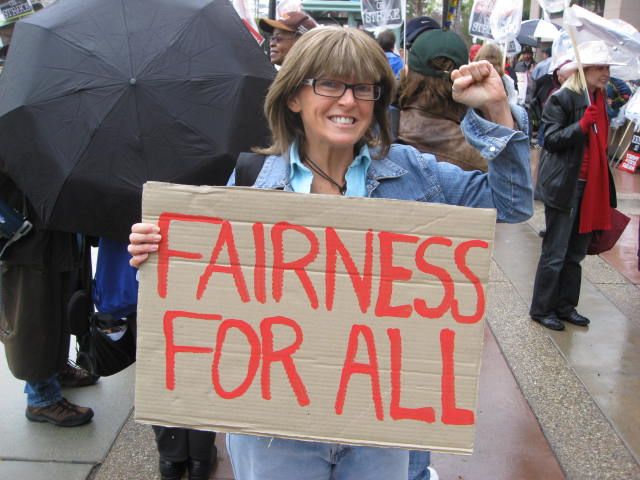
There are a lot of imbalances in our world.  The protests last year about the 1% (richest) having and controlling most of the resources was a reflection of how people feel about imbalances in the distribution of resources .  Equity in simplest terms is about fairness but defining fairness is no simple task.  For example, how society values the work people do is directly related to the level of their salaries.  But is the distribution of salaries, fair?  Are famous musicians and singers or athletes really worth the millions they are paid relative to a doctor, teacher, or the person responsible for placing concrete on the bridge you travel over everyday?  Wealth is certainly unevenly distributed and this has been the case it seems since the dawn of time.  I’m thinking a lot about equity right now as it is very apparent it will be an important factor in how I will need to consider appropriate and fair investments in technology for our schools. I visite...

Designed to Change

Image
There is something seriously wrong with the way some things are designed.  My wife and I were away yesterday and I get a text from one of my kids saying “the fridge isn’t working”.  Sure enough when we get home later, it’s dead!  This is our second fridge in just over 10 years (our first was relatively expensive, the second inexpensive – didn’t seem to matter).  When I mention this to others most often people suggest that 5 years is pretty normal for a fridge.  I think fridges are designed to fail.  So, after I write this blog post we’re off hunting for a new fridge, oh joy…  I probably shouldn’t be writing this post right now in my less-than-happy-about-my-fridge state of mind. However, as you know this is not limited to fridges and not just to products that stop working.  Think about the consumer electronics business.  Cell phones, for example, seem to be designed to be disposed of within 3 years.  Actually, even 3 years is a long ti...

Innovate to a Preferred Future

Image
A lot of people are writing and speaking about innovation these days.  I hesitated to join in but it’s been on my mind lately too so why not see if I can add to the conversation.  Wikipedia (Feb. 25, 2012) starts its article on this topic with “ Innovation is the creation of better or more effective products , processes , services , technologies , or ideas ”.  When I read about the enormous problems facing us today and into the future, I see a rising need for more innovative thinking.  The worlds problems seem overwhelming with automated work , fuel costs and scarcity, war, public and private debt loads, education systems in need of redesign, governments buried in red tape and complexity , and the list goes on.  Small thinking isn’t going to help us solve these problems but innovation can.  The environment for learning matters tremendously as the authors of A New Culture of Learning suggest “ when play happens within a medium for learning—much like a cult...

Equity or Equality?

Image
There are clear examples of inequality in our midst.  This morning I was reading some articles about poverty levels, lack of access to clean water, millions of Americans and others pushed in recent years from the middle to the poor class (2008 meltdown), and the 10’s of thousands of Japanese impacted by the March 2011 earthquake and tsunami.  I wrote about greed and the economy a few months ago and the news and the blogosphere are rife with articles about unequal distribution of wealth, food, property, education, disasters, and opportunities.  History is replete with stories of people living with inequality.  In my assessment I would say the gaps are increasing not getting smaller.  Public education has definitely been a reasonably successful equity builder over the years.  But I would not call education an equalizer.  Nothing in our world is that. I was having a tweet-convo yesterday with a colleague about the inequity that schools and communities ...

Greed, Economy, and Education

Image
I am about 60% of the way through Freefall: America, Free Markets, and the Sinking of the World Economy by Joseph Stiglitz .  Joseph is a recipient of the Nobel Memorial Prize in Economic Studies and covers this topic very thoroughly.  Freefall is an fascinatingly honest retelling of the 2008 great recession and an exposing of the greed and corruption that essentially caused one of the greatest transfers of wealth in recent history.  Self-serving banks loaned money to people who couldn’t afford it based on the “value” of their home growing perpetually and the government allowed it to happen.   Wealth has evaporated from millions of people through loss of home and job around the world – wealth has been transferred to already very rich individuals from poor and middle class people.  The US government has borrowed at unprecedented levels (the burden is on “the people”) and through bailouts given 100’s of billions of dollars to banks with virtually no strings ...

Is the Internet Killing the Planet?

Image
A colleague of mine recently forwarded an article in the Vancouver Sun “ Could the Net be killing the planet one web search at a time? ” to which he responded “if there is a shred of accuracy to this article, the internet is an environmental nightmare of unprecedented proportions”.  I think it really depends on how you look at it… Do you ever think about what happens when you type a few words into a Google or Bing search and click the Search button?  I know I don’t.  But a lot happens behind the scenes 24 x 7 to make that amazing service work and quickly.  Google, Microsoft, Facebook, Amazon, IBM, and now Apple have built enormous data centres around the world to deliver an amazing array of online services.  According to the article I referenced, our Internet search example caused 1-10 grams of carbon to be released into the atmosphere which contributes to global warming.  You might think “1-10 grams”, who cares.  But when you add up the billions of ...

The Future of History

Image
I can’t recall ever enjoying reading about or studying history when I went to school.  It was, well, boring.  It seems that as I accumulate my own history, I become increasingly interested in who and what has come before my time.  I am fascinated with scenarios both historical and future.  For example, key events in history link up to bring us to where we are but what if things were different, even one link in the chain of events? “Coal gave Britain fuel equivalent to the output of fifteen million extra acres of forest to burn, an area nearly the size of Scotland.  By 1870, the burning of coal in Britain was generating as many calories as would have been expended by 850 million labourers.  It was as if each worker had twenty servants at his beck and call .”, The Rational Optimist, Kindle loc. 3236-43. I read that and think ‘wow, what if coal and its use had not been discovered?’ Coal has become and continues to be a key ingredient for most generatio...